
GP Essay Questions (2025) and Thematic Strategies
Looking for the 2024 A Levels Essay Questions? It’s over here!
Practicing prelim questions is an effective strategy to prevent us from stumbling over our actual A Level questions in the exam because it familiarises us with the relevant issues/debates under a specific Theme.
Below are questions from this year’s prelim papers, including the 17 schools*. I have organised them into Themes for our easy reference. I have also added my own insights for each Theme to provide important tips on what we have to take note of if we want to provide critical and quality responses for questions under that Theme. I separated ‘Standard’ questions from ‘Others’ that are more niche or unconventional. I also marked out questions that are more difficult because of various modifiers.
The major Themes to focus on are: Arts, Science & Tech, Individuals & Values, Politics, Media, Environment, General. These themes have been selected based on their frequency in the A Levels. Themes not included here are those that are not common for A Levels (e.g. Education, Sports, Crime, Poverty, Family, Economics)
So below are nearly 160 questions that I have compiled for the year of 2025, all for your easy reference 🙂 If you need more questions, please check out the three-year compilation (2017, 2018, 2019) or 2020, 2021, 2022, 2023, 2024. I have also included some general questions for those of you who prefer to attempt general questions. A detailed explanation of all these 7 Themes are also found here, and it is also something I will discuss extensively in my CONTENT CRASH COURSE (which always happens for 2 rounds from Jul-Aug and Sep-Oct)
*17 schools: ACJC, ASRJC, CJC, DHS, EJC, HCI, JPJC, MI, NJC, NYJC, RI, RVHS, SAJC, TJC, TMJC, VJC, YIJC
Overall Stats (2025 Prelims) | This year’s distribution is actually very similar to the A Levels (past 13 years):
- Arts: 22 | A Levels: 25
- Indv & Values: 22 | A Levels: 24
- Politics: 26 | A Levels: 23
- Sci & Tech: 19 | A Levels: 19
- Media: 14 | A Levels: 14
- Environment: 13 | A Levels: 11
Read the following overview to maximise the benefit of this resource!
Overview (Tips for Effective Revision)
- Prepare content knowledge in a Thematic way to ensure maximum effectiveness during the A Levels where our content knowledge would likely be applicable
- Choose at least 3 Themes to specialise in. Recommended to avoid Themes that are not in these 6 because they do not come up that frequently in the exam
- The new syllabus having 8 instead of 12 questions to choose from = our content knowledge needs to be even more comprehensive and specialised to have a good chance of even having 1 question that we can confidently answer in the A Levels!
- Look at questions to familiarise with what common issues come up for that Theme
- Identify existing gaps in content knowledge and fill in those gaps (come for the crash course for an easy way to quickly address those gaps)
- Use questions for practice; come up with detailed essay plans (20 mins per question) and quickly cover as many questions as possible to increase exposure to the different ways a Theme can be tested
Standard questions are predictable core issues that are a ‘must-know’ when specialising in that theme. These represent 80-90% of all possible questions from this theme. I have analysed 3000+ questions over the years to derive these common issues (quite sure I am the only teacher who is crazy enough to do this haha), so that you can easily spot trends for the theme. Again, you must join the crash course if you would like to find out more about standard questions. My crash course answers all the standard questions, which means my students can always answer around 90% of any question that comes out for a theme they are specialising in. If you would like that too, please do not hesitate to join!
Standard questions marked with ‘difficult’ are usually because they are similar to standard questions but have other specific requirements that make them challenging to address (e.g. around 70% similarity). These require Tweaking – an advanced skill where we adapt our existing content knowledge to easily apply to new questions, greatly amplifying our content knowledge. Again, if you want to learn that, you must try the crash course 🙂
The remaining questions in the section of ‘Lowkey Cooked’ are usually impossibly difficult :(((, and I will explain why that is the case (questions are marked as “LC”)—usually because they are cross-Theme (in a non-predictable or non-synergistic way) or are simply too different from anything we have seen before.
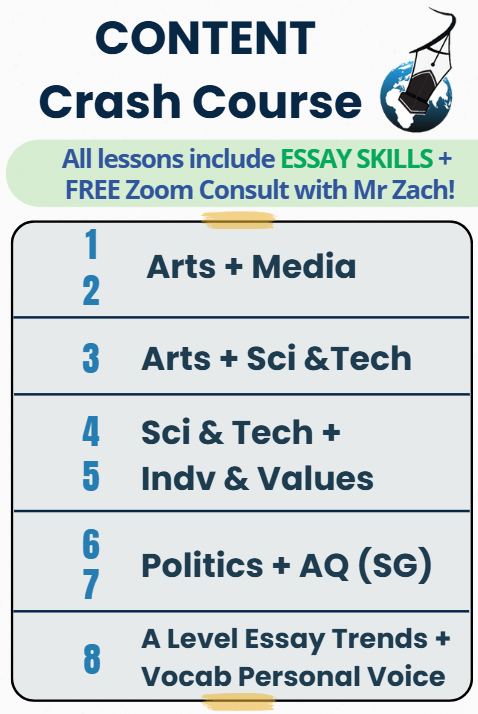
To find out more about the essential arguments to answer any standard question, check out our 8 Lessons Content Crash Course that offers 150+ arguments and 350+ examples to cover all these standard questions! In just 8 lessons, you will easily master all the content knowledge required and feel very confident for the A Levels 🙂 Lessons are all online and recordings are also available even if you can’t make it! Click here to find out more and sign up
1. Arts/Heritage
Arts (Standard)
- To what extent are the arts able to encourage constructive dialogue in your society?
- Assess the value of staging major entertainment events in your society.
- ”The Arts have lost their significance today.” How far do you agree?
- Consider the view that comics or their screen adaptations hold little educational value today.
- Consider the view that buildings in your society should be beautiful and not merely functional. Difficult
- Has your society done enough to promote the arts?
- ‘Tradition stands in the way of progress.’ To what extent is this true in your society?
- To what extent is the local arts scene valued and supported in your society?
- How important is it for countries to preserve their cultural heritage?
- “The arts are not valued for itself.” Is this an accurate reflection of your society?
- ‘The promotion of the arts is nothing more than an economic endeavour.’ To what extent is this true of your society?
- Are physical bookstores still relevant? Difficult
- ‘There is a decline in the appreciation of traditional art forms today.’ How far is this true in your society? Difficult
- Do cinemas still have a role to play in an age of digital streaming? Difficult
- Should societies still hold on to tradition in face of modernisation?
- ‘Art can be a form of protest.’ Comment.
- ‘There is not enough support for the arts.’ How true is this in your society?
- To what extent should cultural heritage be prioritised over economic development in your society?
- How important are the arts in shaping national identity in your society?
- Are artists still relevant in an age dominated by digital tools?
Arts [Lowkey Cooked!]
- In this digital age, are museums still relevant?
- “Good language skills are no longer necessary as technological developments become more sophisticated.” Discuss.
Once again, I would like to highlight that this is the MOST FREQUENT theme appearing in the A Levels, do not let these prelim questions mislead you into ignoring this wonderful theme. MANY BENEFITS: Standard questions with many overlaps + easily shows personal voice due to vocab used + easy to differentiate from other students + fun examples that are easy to remember. Check out my model essay for Films shared in my Telegram channel (it was my actual essay as a student taking the A Levels in 2014)!
Insight/Strategy:
This year’s prelim questions have a lot from the arts, which is great because it aligns with A Level trends! It seems that schools have finally caught on (remember Arts is the MOST frequent Theme that comes out for the A Levels – 25 in 13 years)
When we look at Arts, one of the key question lies in its Value – whether or not the arts has value and can serve a certain function (think of it like useful vs useless/problematic). This exists at the core of Arts questions but are often phrased in different ways. We need to ensure that we do not just regurgitate the content we are familiar with. Instead, we should address the key terms (e.g. encourage dialogue, protest, have significance).
For the more specific or varied art forms like films, literature, television adaptation, we would need to have concrete examples for these even if the arguments are similar to the more general idea of ‘the Arts’. Do note that the various forms of the arts include: films, music, literature, painting/sculpture/exhibition, theatre, comics, architecture. Out of these, usually films, literature, and music are the most common and can exist as the sole focus of a question. This year, the only specific art form is poetry (a sub-set of literature, but it precludes the discussion of stories in other forms).
This year’s big trends first apply to efforts towards the arts. This is a distinct type of question (e.g. questions consider the kind of treatment / attitudes / support / funding given to the arts, rather than its inherent value). It requires an evaluation of the efforts taken, not just discuss what is good or bad about art (predominantly from the perspective of the entire country). They also very commonly revolve around SG, so it will be good to recap SG arts examples!
The area of heritage/tradition also revolves around the idea of value (specific questions may examine whether it has value amidst modernisation and development). Tradition is a little broader but still belongs to Arts because art is usually the conduilt we use to preserve traditions.
Analysis of Difficult Questions:
- Specific art forms: Architecture, traditional art forms | 5, 13
- Specific venues (even harder because we need to consider what the place does for the artwork): museums, bookstores, cinemas | LC1, 12, 14
- LC2 about language skills should just be avoided, too niche
Pros-Cons of this Theme:
- Highly common in the A Levels [RANK 1]
- Less popular with students = Easier to differentiate yourself and score well
- Questions are often very standard. Just by knowing arguments about value of art can already answer many of the questions below (can refer to the sample essay I have shared on the value of films) |Tip: Take the stand that art has value! It is much easier to argue and shows that we are cultured 🙂
- Honestly, no cons!
2. Science
Sci/Tech (Standard)
- Access the view that scientific progress is always worth the risks it poses.
- To what extent can the regulation of artificial intelligence be justified?
- ‘Our use of technology has narrowed, rather than broadened, what we experience.’ Discuss.
- Evaluate the claim that modern technology has only made inequality worse.
- To what extent is technological advancement in warfare a cause for concern today? Difficult
- Consider the view that science solves all problems.
- Is the pursuit of convenience making our lives more difficult? Difficult (Sci + Env)
- To what extent should governments regulate the development and use of artificial intelligence?
- ‘It is never justifiable to disregard ethical concerns for the sake of scientific or technological progress.’ Discuss.
- To what extent is technology an effective solution for human loneliness? Difficult
- Does the pursuit of profit undermine the healthcare industry? Difficult
- Consider the view that science and technology promise more than they deliver.
- Has society become too dependent on data to make decisions? Difficult
- ‘Human values are overlooked when decisions are based on data.’ Evaluate this claim. Difficult
- Is science always reliable?
Sci/Tech [Lowkey Cooked!]
- To what extent is the management of infectious diseases the most pressing global issue today?
- ”Modern technology will mean the end of education.” Is this a fair statement of your society? (Media + Education)
- “Good language skills are no longer necessary as technological developments become more sophisticated.” Discuss.
- How far do you agree that young people in your society can be hopeful about the future? (Societal change + Tech advancement)
Insight/Strategy:
The first main issue lies with Impact. However, given that Sci & Tech questions often have complex modifiers that add niche requirements to the question, we would need to tweak our arguments to address these different ideas of impact. We need to pay attention to the specific impacts the question chooses to focus on (e.g. narrow/broaden experience, impact on inequality, solves problems, gives convenience, delivers on promises, solution for loneliness).
It becomes important to really interpret these terms and consider how to address them instead of merely regurgitating pros-cons. Notably, 2023 and 2024 A Level questions from this area looks at really niche types of tech (rather than give us the freedom to discuss any type we like): space exploration, waste disposal. Prelim questions for ST are often easier than what actually comes out.
The next big group looks Artificial Intelligence (AI) and this year we see interesting focuses including regulating AI and the impacts of relying on big data (an aspect of AI).
Another group of questions examine whether there are or should be any Restrictions/Limitations on Sci & Tech. Such questions overlap heavily with ethics because ethics is the foremost rationale behind wanting to regulate. This particular issue is always popular—a timeless concern in this Theme.
Note the difference between scientific research and technology. Remember that scientific research refers to the knowledge, theoretical and academic aspects whereas technology refers to the applied and practical uses. For instance, social media is a technology but it is not related to scientific research. It is important to clearly note whether the question engages with Science or Technology, and to use the suitable examples.
Analysis of Difficult Questions:
- Specific tech types (requires niche examples): Healthcare, Education | 11, LC1, LC2
- LC4 requires us to also consider non-tech changes, which means the scope is much broader and if we don’t have cross-theme knowledge, we cannot attempt this
Pros-Cons of this Theme:
- Highly common in the A Levels [RANK 4]
- Students are usually exposed to ideas of tech in schools and in their lives, making this quite relatable (can tap into prior knowledge)
- More popular with students = Harder to differentiate yourself and score well (this is usually the most attempted question in every year!)
- Questions are not standard, there are many variations that make it difficult to answer without proper question analysis | Exception: Questions about impact are quite standard, just need to adapt arguments and examples to ATQ
- Examples are difficult – need to be updated (since Sci & Tech is constantly and rapidly advancing) + must avoid cliché examples that many students like using
3. Individuals & Values
Individuals & Values (Standard)
- It is better to be feared than loved. How true is this of leadership today?
- In an increasingly volatile world, is the pursuit of self-interest always bad?
- Examine the view that in all areas of life, flexibility is key.
- To what extent should individuals be concerned with world affairs, when they have little ability to influence them?
- ‘Competition does more harm than good.’ How true is this of your society?
- Should young people in your society be encouraged to follow their passions?
- ‘We have too many choices today.’ How far is this true? Difficult
- ‘Politicians should receive harsher punishments for their crimes than ordinary citizens.’ Discuss.
- ‘Today’s youth are too pragmatic.’ To what extent is this true of your society? Difficult
- Is being compassionate always desirable?
- Do people in your society care too much about what is happening in other countries? Difficult (Activism + International relations)
- Should young people in your society be more involved in shaping national policies?
- ‘There is value in doing nothing.’ What is your view?
- Is consensus always desirable?
- ‘A popular leader is a good leader.’ Discuss.
- ‘The pursuit of perfection is both unrealistic and harmful.’ Discuss.
- Is fear really a bad thing? Difficult
- ‘The individual wields more power than the government.’ To what extent is this true today?
Individuals & Values [Lowkey Cooked!]
- Evaluate the measures taken in your society to promote social cohesion.
- Should the value of a person’s work be measured solely by monetary compensation?
- How far do you agree that young people in your society can be hopeful about the future?(Socio-political Change + Tech)
- Assess the argument that your society does not embrace change enough. (Socio-political Change + Tech)
Insight/Strategy:
I came up with this Theme, so you wouldn’t find this anywhere else! This is a very easy-to-master Theme, and also something very commonly tested! Individual/Values are questions that are more philosophical in considering the importance of different values in an individual’s life (e.g. Success/Adversity, Happiness, Competitiveness vs Selflessness, Freedom/Originality/Conformity, Integrity). We can do very well when we realise how these questions are repetitive. You will see many similar questions below that essentially ask about the same thing. The strategy lies in how we are able to tweak our content knowledge to handle different phrasings (a common strategy across Themes that you will notice I keep emphasising and are also teaching in my crash course and weekly lessons!).
For Success, questions prompt us to ponder what defines success and whether our societies are emphasising traits related to success (e.g. follow passions, pursue perfection, embrace fear, pragmatism, doing a lot vs doing nothing). Notably, the traits in 2025 are actually less conventional and quite different from past question trends; these are less direct and require tweaking usual arguments to address them. But it still falls in the standard category.
For Non-conformity, questions are interested in whether there is value in being daring to challenge norms or try something different (e.g. freedom to make choices, flexibility). You will notice there are significant similarities across these topics because they all relate to values found in an individual’s life; this makes it easier because knowing one issue helps with arguments for another. Note: these values may also be embodied by countries/organisations and these can be also be used for examples unless the question’s focus only relates to individuals.
The structure of the essay response becomes fairly straightforward where we analyse the pros-cons of these values, or discuss whether society offers a favourable environment for some of these values.
This year’s big winner (as always the case in both Prelims and A Levels) is definitely on Social movements and Activism to consider its value and importance (e.g. individuals being concerned about global affairs and trying to influence them, shaping national policies, exerting power to influence the government). Activism is categorised here because individuals are drivers of activism and they use activism to manage power dynamics with governments, Also, activism synergises beautifully with the other values being mentioned above (like success, selflessness, or non-conformity). Furthermore, it also aligns with major Themes like Media, Politics and Arts because all of these have questions looking at how individuals fight for change in society and let their voice be heard by others and by the government.
Activism has always been an incredibly popular question type. In 2022, I predicted this and it did come out and recurred again in 2023, and yet again in 2024! 2025 may still find ways to focus on the same issue, but with a different question framing. Main trend = discuss the Value/Effectiveness of Activism .
Analysis of Difficult Questions:
- Q17 is a specific emotion and we need to think about the situations where we experience fear. 9 is very niche. 7 needs thorough interpretation and tweaking from other topics too.
- There are many “in your society” questions for IV and these limit the kinds of examples we can discuss. It would be recommended to think of examples pertaining to SG when we prepare for this topic.
- Too specific: Social cohesion, value of work | LC1, LC2
- Requires significant ST + P knowledge | LC3, LC4
Pros-Cons of this Theme:
- Highly common in the A Levels [RANK 2]
- Less popular with students = Easier to differentiate yourself and score well
- Questions have a lot of overlaps, making it easy to adapt arguments we know for many questions in this theme
- Have a lot of synergies with other Themes also because of how general it is
- Honestly, no cons!
4. Politics
Politics (Standard)
- “Diplomacy, not deterrence, is the key to preventing international conflicts.” How far do you agree?
- How far is it acceptable for the rights of individuals to be violated for the greater good of a society?
- Consider the argument that cooperation among countries is only motivated by self-interest.
- Assess the view that in today’s world, migration is essential for countries to thrive.
- ‘ A lot of talk and very little action.’ To what extent is this true of international organisations?
- ‘Strong ambition, weak execution.’ Is this a fair description of governance today? Difficult
- ‘Our world needs to move from managing crises to preventing them in the first place.’ To what extent do you agree?
- How important is diplomacy in today’s world?
- ‘The individual wields more power than the government.’ To what extent is this true today?
- How far should the state intervene in matters relating to one’s body? Difficult
- ‘Boundaries no longer matter.’ Is this claim valid in today’s world?
- ‘Politicians should receive harsher punishments for their crimes than ordinary citizens.’ Discuss.
- Given the increasing uncertainties today, is global cooperation still feasible?
- Should governments prioritise individual freedoms over the security of the country?
- ‘Mind your own business.’ Is this good advice for world leaders today?
- Is foreign aid ultimately more damaging than beneficial to the countries it aims to support?
- Is it right for a leader to place national interests above global responsibilities?
- Is modern day politics nothing but a series of empty promises?
- Evaluate the claim that foreign aid does more to benefit the donor than the recipient.
- Do global challenges divide more than they unite?
- Diplomacy matters more than military strength in today’s world. Discuss.
- ‘The responsibility for the well-being of the population lies with the government.’ Difficult
- How far is economic success an accurate reflection of a country’s overall wellbeing?
Politics [Lowkey Cooked!]
- ”Small countries should be taken seriously today.” How far do you agree?
- Is meritocracy still the best way to run a country?
- Evaluate the effectiveness of government efforts to enhance people’s quality of life in your society.
- ‘Politicians should receive harsher punishments for their crimes than ordinary citizens.’ Discuss.
Insight/Strategy:
Politics is an incredibly popular theme both in the A Levels and in the 2025 Prelims. The two main branches of Politics questions look at International Relations (External) and Governance (Internal). International Relations is a big winner this year, look at how many questions relate to this! IR includes looking at International Cooperation and Diplomacy and considering whether they work (e.g. not only self-interest, actual action over talk, can unite rather than divide, is important, matters more than military strength, is not just empty promises). These two concepts of IC and Diplomacy are linked because countries work together to try and resolve conflicts in a peaceful way, rather than resort to military conflicts.
The beauty of IR questions is that they are all really similar, and the examples are major case studies that are easy to remember and provide significant credibility when used in an essay. But do take note not to mention cliche examples like WWII stuff, and instead think about recent and even ongoing conflicts (e.g. Russia-Ukraine, Israel-Palestine, South China Sea dispute)
Governance looks at the factors that determine good governance and whether it exists (e.g. fulfiling promises, strong implementation, caring for well-being). These are quite diverse so the overlap between questions is less but all of which will examine the quality of leadership in running a country and what is being prioritised.
Another bulk of Politics questions in 2025 come from Restriction of Rights. These questions consider whether it is justified for governments to violate certain human rights and implement intrusive policies (e.g. violate individual rights, ignore individual freedoms, intervene in matters relating to one’s body).
Analysis of Difficult Questions:
- 6 requires thoughtful engagement of the key terms (ambition vs execution)
- Specific: Body, Small countries, Meritocracy | 10 LC1 LC2
- LC3’s scope is limiting because we can only look at policies related to QOL
- LC4 is also more specific than accountability because it only for crime and punishment
Pros-Cons of this Theme:
- Highly common in the A Levels [RANK 3]
- Less popular with students = Easier to differentiate yourself and score well
- Questions are often very standard. Mastering this theme requires just two main areas of knowing about external international relations between countries and the internal governance within a country |Tip: Start realising that countries and governments may not always be so altruistic, and your essays will sound much more nuanced and matured!
- Examples are easy because an issue happening to a country is a major one, which means that the same issue can be framed in many different ways to suit different questions
- May be intimidating to try this Theme at the start because there are some technical terms and concepts needed. However, these are recurring ideas across different questions and provide significant value once we are exposed to them!
5. Media
Media (Standard)
- The news should do more than just inform. How far do you agree?
- How far can we trust what we see in the media today?
- ‘Despite living in an interconnected world, people are lonelier than ever.’ Discuss. Difficult
- ‘The media distracts us from meaningful pursuits.’ Discuss
- Assess the view that nothing in the media can be trusted today.
- ‘Never trust what you read and whom you meet online.’ Is this sound advice? Difficult
- To what extent does the media today undermine rather than support democracy?
- ‘Social media has changed who we admire today.’ To what extent does this bring more harm than good?
- ‘New media is a boon to democracy.’ Comment.
- ‘It is dangerous to place our faith in social media influencers.’ What is your view?
- Fads are of no concern since most are so short lived. Do you agree?
- Consider the view that online outrage has done more harm than good.
Media [Lowkey Cooked!]
- To what extent is social media enhancing climate activism?
- Access the view that the media should never withhold information from the public.
Insight/Strategy:
Social media is a clear focus of the current trend of questions. Just like Sci/Tech, the first major area of concern lies in looking at Impacts. The latest trends and also from what we see this year, Impact of Social Media is immensely popular (e.g. distracts us from meaningful pursuits, dangerous when we trust influencers, change who we admire – pros and cons, online outrage – pros and cons, fads and trends – pros and cons).
There are, however, difficult questions for this. Those on loneliness and online relationships are much harder to write about because it is difficult to find convincing examples. Students will usually default to statistics which are not as good as case studies. But for such topics, it is very difficult to find suitable case studies to discuss. For instance, looking at relationships we should examine the case study of online dating apps instead of finding some random statistic. Or, for loneliness, we should look at global reports or at particular countries with high loneliness rates (e.g. Philippines) instead of giving numbers. Essentially, such questions are much harder due to the limited examples available and I usually encourage students to avoid such questions.
Another big area would be Political Media. This is a popular topic in the A Levels too. The questions here specifically look at the impact of media on democracy. Previously, the A Level question looked at impact of modern technology (which is broader). This question is easier and is one we should definitely prepare for, given how these two areas intersect greatly in today’s world.
Media could also explore The Press and News. But this year there is only one question on that. It aligns with the larger trend of questions gravitating towards social media. But such questions are useful to practice because it broadens our examples beyond just social media, realising that the media also comprises profeesional agencies. We can then consider what is their role, which can also help answer other questions about trust and reliability, because agencies are supposed to produce high quality content.
Analysis of Difficult Questions:
- Specific: Relationships that are online are hard to back with examples | 3, 6
- Cross-theme: Climate activism | LC1
- LC2 is quite odd, and requires a lot of tweaking because it is not a commonly discussed issue. Usually it’s about how the media presents information, not that they withhold it
Pros-Cons of this Theme:
- Overlaps with many other Themes
- Students are usually exposed to ideas of media in schools and in their lives, making this quite relatable (can tap into prior knowledge)
- More popular with students = Harder to differentiate yourself and score well
- Relatively less common than other major Themes, inconsistent (some years it does not appear) [RANK 5]
6. Environment
Environment (Standard)
- “Environmental conservation is a futile endeavour.” To what extent is this true?
- To what extent can climate change be addressed without sacrificing the comforts of modern life?
- ‘Environmental sustainability is an unattainable goal for the poor.’ Comment. Difficult
- Examine the view that environment efforts are futile as long as a materialistic society exists.
- ‘We are less concerned about environmental issues than ever before.’ Is this true of your society?
- ‘We are powerless against climate change.’ Discuss.
- ‘Developed nations should shoulder a greater burden in addressing climate change.’ To what extent do you agree?
- To what extent is social mediaenhancing climate activism?
- Can young people make a real impact on environmental conservation in your society?
- ‘In today’s world, tourism inevitably harms the environment.’ Discuss.
- To what extent can an environmentally sustainable lifestyle be achieved in your country?
- Is the pursuit of convenience making our lives more difficult? Difficult
- Is environmentalism today more about image than impact?
Insight/Strategy:
Unfortuantely, Environment questions have been increasingly unpopular. We hardly see them appear at the A Levels (11 times in 13 years, compared to the more popular themes appearing around 20+ times). This trend is reflected in every year’s prelims, including in 2025. Many students still treat this as their primary Theme that they are working on, which I would actually discourage. The inconsistency makes it unreliable and not worth the effort.
The first main focus of Environment questions looks at the Severity of the Problem (e.g. we are powerless). The next one that is very popular this year looks at Evaluating Solutions and considering whether they are effective or feasible (e.g. futile endeavour, unattainable for the poor, people are less concerned, futile against materialism, more about image than impact).
Such questions about solutions are quite easy to address because there are many overlaps. Have a huge pool of examples for various environmental solutions: activism, policy and legislation, corporate initiatives, education, individual change in behaviour, reducing consumerism, international cooperation etc. Then, think of various arguments that explain why they would be effective or ineffective. Of course, link your arguments to the specific claim in the question!
Relatedly, we also look at Stakeholders (e.g. youth, developed countries) to consider their role and impact. Other issues are Tensions, the forces at play that continue to worsen climate change (e.g. materialism, tourism, convenience and tech advancement).
Analysis of Difficult Questions:
- 3 looks at the feasibility of solutions for only a specific group (the poor)
- 12 is broader than just the environment since “difficult” is not just about environmental degradation
Pros-Cons of this Theme:
- Students are usually exposed to ideas of environment in schools and in their lives, making this quite relatable (can tap into prior knowledge)
- Questions have a lot of overlaps, making it easy to adapt arguments we know for many questions in this theme
- More popular with students = Harder to differentiate yourself and score well
- Relatively less common than other major Themes (basically the least), inconsistent (some years it does not appear) [RANK 6]
7. General
FAQ: Why are these not considered major Themes?
Answer: They do not come out frequently enough, both in the A Levels and Prelims. So if you thought this is a Theme, you would need to quickly pivot now to pick from the above instead! These are just backup questions that you can learn, but they do not count as a Theme. Remember, you must choose 3 out of 6 Themes from above to get a good chance at having at least 1 out of 8 questions you can answer in the exams. Again, if you are feeling lost and overwhelmed, please just sign up for the crash course so that I can guide you. In just 7 lessons, you can easily progress through mastering these themes. Many of my students have successfully done it before you, and so can you 🙂
Sports
- Evaluate the effectiveness of your society’s effort in promoting a sporting culture.
- ‘Given the limited resources each country has, funding should only be channeled to sports that perform well.’ Discuss.
- ”Sport is the most powerful tool a nation has to inspire pride.” Discuss. Difficult
- Access the view that commercialisation of sport has undermined its original values.
- Consider the impact of commercialisation on sports today.
History/Humanities
- Is an understanding of the past still a reliable guide for the present?
- Can history be truly objective?
Equality/Diversity
- In a highly competitive world, do women make better corporate leaders than men?
- How desirable is it to have a minimum wage in your society? Difficult
- To what extent does your society really accept people with disabilities?
Education
- ”Modern technology will mean the end of eduction.” Is this a fair statement of your society?
- Examine the importance of play in education.
- Do schools still have a future in a technologically advanced world?
- ‘Education has failed us.’ How far is this true in your society?
Crime
- Do you agree that people should always be given second chances?
- ‘Harsh laws make peaceful societies.’ How far is this true?
Insight/Strategy:
General questions for this year come from a few key areas: Sports, History/Humanities, Equality, Tourism, City Living, Education. We should remember that these General questions are not individual Themes on their own because they are not as popular for A Levels. These General questions should be viewed more as a backup Theme rather than a main Theme that we are preparing for.
These ones that I have selected have some synergistic overlaps with the main themes above (those that do not overlap have been excluded, i.e. family, business, religion, health)
- Sports: Overlaps with Individuals & Values, Politics
- History/Humanities:Overlaps with Politics, Arts (arguments)
- Equality/Diversity: Overlaps with Arts, Media, Individuals & Values, Politics
- Education: Overlaps with Arts, Media (these are alternative ways to gain knowledge), Individuals & Values (success)
Out of these, Sports is actually the most promising. I have been tracking A Level trends; it is the most popular out of all these general issues (in this year’s prelims as well). If you really want to pick one, you may consider Sports especially since the examples here can very likely apply to other IV questions too!
________________________________________________________________________________________________________________
It’s 4 more weeks before the A Levels! The last lap can be nerve-wrecking but it can also be game-changing! I have seen many students make tremendous and miraculous improvements in the final lap.
Join us in our crash course for a last lap booster in just a couple of hours, reach out on WhatsApp or Telegram over here! All lessons are also recorded for easy access, Our crash course offers 150+ arguments and 300+ examples!
That being said, good luck for the upcoming exams. Take care of yourself, please ensure not to burn out in this period!!
Check out the most recent 2024 A Levels Questions Analysis here 🙂
________________________________________________________________________________________________________________
If you found this helpful, do check out the very popular (1.4k subscribers in Oct 2024) GP Tips & Resources Telegram Channel! Click here to join. This channel is meant to act as a GP companion to share knowledge and help all students, regardless of whether they are a part of ZAscension. Everyday there will be Tips of the Day, Answers to FAQs, Articles and many more. So if you enjoyed this article, this channel will definitely be useful for you 😃
Thank you for stopping by ZAscension
Find out more about the writer, Mr Zach!
 WhatsApp 9722 3187 (click to contact) to sign up for lessons 😃
 Check out our GP Tips & Resources Telegram Channel! Click here to join