GP Essay Questions from 2025 A Levels
1. ‘No country should sacrifice its economic development in favour of preserving the environment.’ Discuss.
2. Assess the view that only well-known works of art can be considered great.
3. ’The most important aim of a scientist is to satisfy human curiosity about the world.’ Evaluate this view.
4. How far do you agree that media coverage of celebrities has a positive influence on young people in your society?
5. ‘Democracy is the perfect form of government.’ Discuss.
6. Examine the claim that it is the responsibility of wealthier countries to assist in dealing with natural disasters.
7. ‘Learning facts is no longer necessary because information can be instantly accessed online.’ Evaluate this statement.
8. To what extent do you agree that enough is done in your society to encourage a healthy lifestyle?
Poll (Which question did you attempt): Indicate in the Telegram poll!
If you want more Tips for GP, do also join this free Telegram channel which would share very helpful Tips, FAQs, and update you when articles are updated/posted 😃
______________________________________________________________________________________________________
General Insights:

Are they really easy this year? Yes! Because they are super standard. But what does standard even mean? Well, standard = we would have logically prepared for this kind of question in our content, based on past year question trends. Standard also means that applying the usual skills should get us to an A!
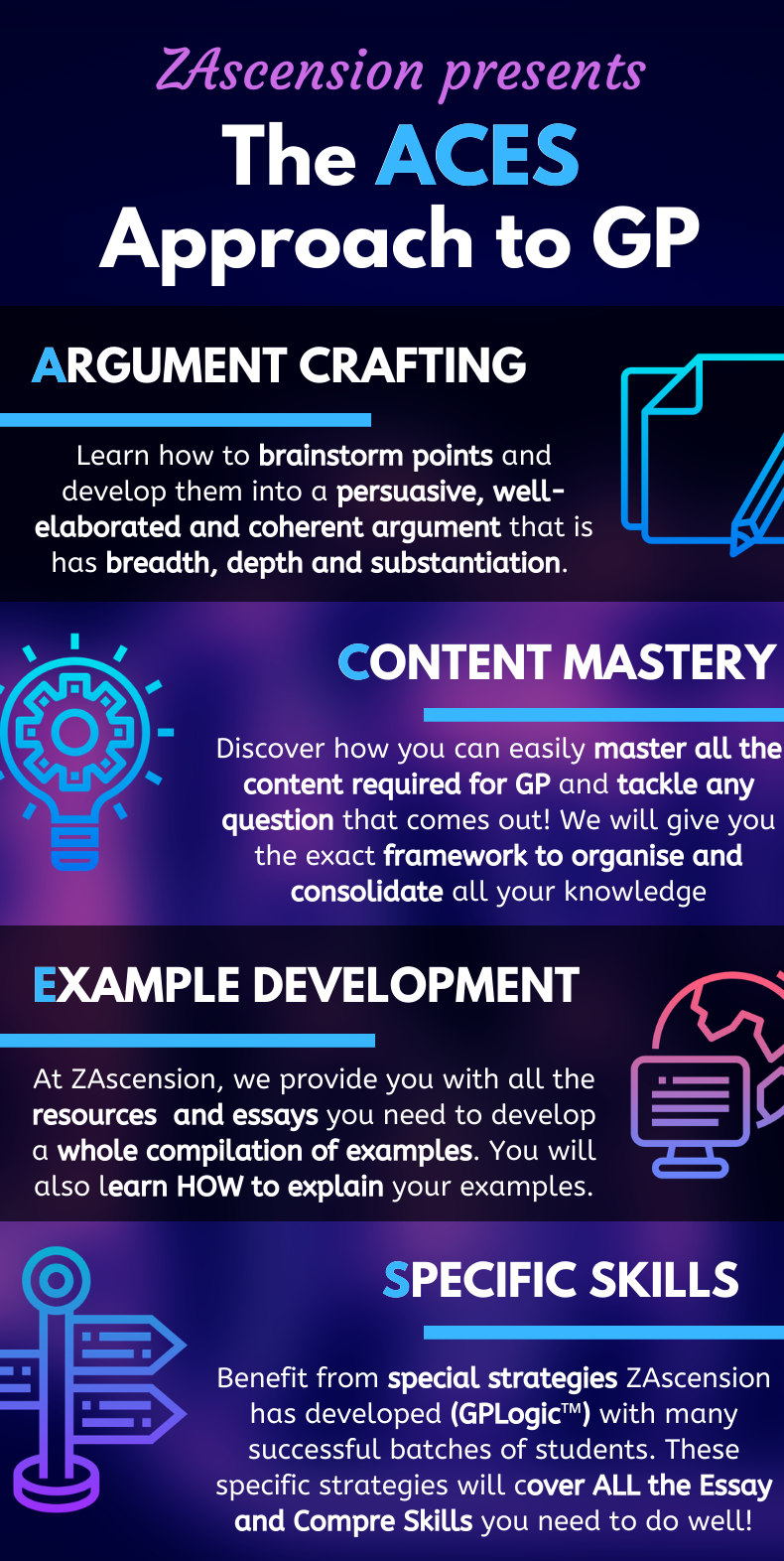
Strategies = Content + Skills. This two-pronged is exactly what we focus on at ZAscension, helping students acquiring specific Thematic knowledge while developing extensive skills that will greatly enhance the quality of essays.
Here is the spread of 2025 questions according to Themes:
Arts (1): Q2
Individual & Values (2): Q4*, Q5*
Politics (2): Q5, Q6
Sci & Tech (1): Q3
Environment (1): Q1
Media (1): Q4*
General (2): Q7, Q8
* = Partially related to the Theme, but not a complete fit (requires additional knowledge apart from the standard arguments and examples we learn for that Theme)
Relatively standard questions from major Themes: 1, 2, 3, 5
Questions that are non-standard but still easier to write: 4, 6
Difficult Questions (too niche / many modifiers): 7, 8
Read the analysis below for more details on why these are classified as such! To be clear, difficult questions do not immediately mean we won’t do well. It just means that it takes more for the essay to address question requirements, but if pulled off well, can still be a great piece!
Studying for GP Content through Major Themes is highly recommended
I have always been sharing with students that my approach in Content Knowledge for GP resides in preparing for major themes. It gives us a systematic method of acquiring knowledge that we would need and ensures that our knowledge can directly be applied to questions. Though the syllabus has changed in 2024 and there are only 8 questions. The 2025 GP A Levels has confirmed, once again, the importance of these major themes. The themes stated above are precisely the ones I have identified all along, and you can see that’s how we organise all the past year Prelim and A Level questions too (also aligning with how I design my crash course and weekly lessons).
For easy access, here are the links to other past year questions organised based on Themes: 2024 A Levels, 2023 A Levels, 2022 A Levels, 2021 A Levels, 2020 A Levels, 2019 A Levels |2024 PrelimsGeneral Paper (GP) Essay Questions 2024 and Thematic Strategies,2023 Prelims, 2022 Prelims, 2021 Prelims, 2020 Prelims, Prelims Compilation from different years
Out of the 8 questions, 6 of them belong to the major themes (just like in 2024!! There is a consistent trend). This is why it is important to be strategic and focus on these major themes instead of working on other niche topics. Out of the 2 General questions: 1 on education, 1 random (health). These 2 questions are very niche topics that cannot be considered Themes because their scope is small and barely come out for the A Levels (looking at statistics from the past 10 years). Excluding this year, education has 4 – these are out of 13 years, whereas other major themes can easily have more than 20 questions. Based on recent trends, out of the general topics, Crime and Sports are probably the most worth studying for. But that being said, the major Themes are still much better!
The insight from here is that the dominant GP strategy is to take a focused approach in developing a critical understanding of these Themes and the associated issues found in them. Students who have specialised and comprehensive knowledge about a specific theme are always rewarded with questions that directly apply their knowledge.
Embracing less popular Themes. and preparing for several key Themes
This year’s A Levels is honestly easier, one of the easiest years I have seen in fact (which means the upcoming years will definitely be tougher because it’s only easy once ever few years). It’s easy because many questions are highly predictable. They very nicely fall into the key standard topics from the major Themes. Each Major Theme has 7 standard topics that represent 90% of possible questions. If you are interested to know how to address these topics, you need to join our lessons because we have key arguments and examples for all these. It affirms my strategy for GP, which is to prepare for content in a specialised and targeted way. Sci & Tech is usually difficult in recent years, but this year’s question is very straightforward. The Media question is a little more difficult because it needs knowledge from Indv Values, but it is still doable.
Beyond that, themes that are less popular with students (but what I always tell my students to focus on), are prominent as usual – Arts, Individuals & Values, Politics! The question about democracy marks the 4th consecutive year where questions either partially or entirely test Activism (people fighting for change in society, or directly participating in politics). The insight here is that some types of questions can very much repeat year after year; the key is of course knowing which ones. How did I know to prepare students for these kinds of questions? I have analysed 2000+ questions from Prelims and A Levels to be able to understand common questions that commonly feature in the exams 🙂 This is why I am extremely confident in my teaching approach for GP because content I share is always applicable to specific essay questions, and not just general knowledge about random things in the world.
Furthermore, cross-theme questions are not uncommon, which is why GP preparation requires us to specialise in at least 4 of the 6 major Themes, and of course to look at the right topics within those, so that our knowledge can be easily applied to actual questions. Many of my students also love the Arts question because it is also a very easy question that looks at value, with a small twist on “well-known art”. Notably, specialising becomes even more critical for the new syllabus because having 8 instead of 12 questions (a 33% decrease!) means that we really have way fewer choices.
Additionally, Individuals & Values is a Theme I (Mr Zach) created upon analysing question trends, and it is not something that schools typically cover. I created this Theme when I saw huge similarities in questions that can be categorised under here, and it is also something I cover extensively in my yearly Essay Content Crash Course (find out more here). Indv & Values is a great theme to look into because of how frequently it comes out and how simple it is to learn this Theme. It also often synergises well with other Themes (both Q4 and Q5 this year are IV, even though they are also Media and Politics respectively). For more information, please refer to the past year questions (links provided both in the above paragraph, and all the way below this article).
Environment has also returned for another year, this time with a standard question too (tensions between environment and economy). This is a simple question that requires us to consider how to navigate these tensions and which to prioritise. Many typical case studies discussed in Environment essays can be used here.
I think it is a very clear signal that A Levels GP has clear content trends and can be effectively studied for. In fact, the existence of such standard questions would mean the disparity would be very huge, between students who prepare well and students who don’t. Students who have no proper strategy for content and only rely on school lectures would also have little confidence in answering A Level questions, even when they are easy.
I would like to add that the new syllabus actually has the exact same questions as the old one, except that the old one has another 4 extra questions. This effectively shows us that all the question trends from the past years are still very relevant because content for GP has not changed!
Skills are important to help us address varied questions requirements
Question requirements are often complex with modifiers (additional requirements) and there could even be more than one modifier.
Interestingly, 7 out of 8 questions this year have at least 1 modifier, and some questions even have multiple variables (aligns with recent A Level trends). This demonstrates the importance of properly analysing questions such that we sufficiently address all the additional requirements 🙂
Q1: Absolute (No country), Variables (economy vs environment) | Q2: Absolute (only well-known works of art) | Q3: Absolute (most important) | Q4: Context (in your society), Extent| Q5: Absolute (perfect) | Q6: None 🙂 | Q7: Context (information can be instantly accessed online) | Q8: Context (in your society)
Context: Q4, 7, 8 | Absolute: Q1, 2, 3, 5 | Variables: Q1 | Extent: Q4, 8
Here is a quick summary of the skills needed (CAVE):
Context = Examples and arguments need to reflect the context/condition and not just ignore it. This includes ‘in your society’ questions because they are only looking at the specific context of Singapore. Other common contexts include ideas about the state of today’s modern world (Q7); we need to evaluate how that relates to the topic in that question (i.e. education). In other words, how does the ease of information access impact education?
Absolute = One view needs to express the absolute. The other view questions the absolute by looking at its limitations or by considering other alternatives to it. For example, for Q2, Agree = only well-known works, Disagree = other works can also be great. Take note only 1 view has the absolute, not both views. With reference to Q1, Agree = No country should sacrifice, but we would not say Disagree = all countries should sacrifice; the absolute is only found in the Agree view.
Variables = Both variables always have to be addressed together. They are no longer important individually, but relatively (to each other). This is one of the most challenging modifiers to address because a lot more need to be explained. We have to remember to always keep a vigilant lookout for the existence of such additional requirements, instead of eagerly jumping into thinking of points! Look at the following section for more details. This cannot be easily summarised here, but simply put all arguments and examples now must include a comparative element. Comparison happens within each BP, not across.
Extent = Need to show how both views could be valid to a degree. Avoid phrases like ‘I agree to a small/large/certain extent’ because they are too vague. Instead, give the specific extent of why you have chosen one view over the other. For example in Q4, a possible stand would be: ‘While the media spotlights some inspirational narratives of celebrities, a lot of the other coverage is much less meaningful in how scandals are being sensationalised’. This would signal that the dominant view is ‘Disagree’ (= disagree to a large extent, but phrased in a much more evaluative and specific manner).
Questions with multiple variables are common curve balls
Q1: Environment
With regard to the variables here, the key to addressing them is to understand that the Scope of our essay has expanded into additional areas of concern. Q1 needs us to think about how these variables interact. For instance, it would be wrong to simply say that preserving the environment is important. We need to explain why it is important enough to justify sacrifice economic development. Vice versa, we cannot only discuss the necessity of economic development without explaining why that is more critical than protecting the environment.
Multiple variables questions are harder because we have additional requirements to consider. Note that every single body paragraph (BP) needs to address both variables and compare them. The common mistake is to separately discuss them across different paragraphs; it is problematic because the arguments would lack the comparative element.

______________________________________________________________________________________________________
If you want more Tips for GP, do also join this free Telegram channel which would share very helpful Tips, FAQs, and update you when articles are updated/posted 😃In 2025, I have also created a huge Example database + arguments + model essay plans, all found on my Substack
Specific Analysis:
I will be analysing each question for their unique requirements, highlighting some pertinent issues, and sharing possible arguments. Disclaimer: these would of course not be the only points that are accepted. If you thought of a different point, it might be a strong argument too, don’t worry just because it is not found here. I just wanted to share some points to open up perspectives on how we can approach these different questions.
This year I am giving more emphasis to the part about Tweaking. Tweaking is a highly advanced skill I teach my students, where we adapt arguments and examples from model essays we are familiar with (those that I have written) and then apply them to tons of different questions. This works when we can identify similarities, while also accounting for differences that would change how we frame our arguments so that they can ATQ! It will be in the last section of every question below.
I have also included a part of ‘why it exists and what it entails’ to unpack the intricacies of every question and explain the larger context around it. Cogitating on this question allows us to more critically examine the issue to consider the tensions that exist within and identify the central concerns. This year, I am also adding a new section for ‘Rating’ to discuss how challenging a question is. For simplicity, I will also have 2 categories of either ‘difficult’ or ‘standard’.
1. ‘No country should sacrifice its economic development in favour of preserving the environment.’ Discuss. | Rating: Standard
- Why it exists and what it entails: This a super standard question for Environment questions, because it is an age-old debate to examine the tensions between the economy and environment.
- Essentially, these two are quite often contradictory, and our chase for economic productivity requires sacrifices from the environment. Vice versa, conservation and sustainability requires us to scale back on economic developments
- For such a question, the more logical and intuitive stand to take is to disagree with the absolute and explain that some countries or even most countries should definitely balance these better.
- Agree (No countries should sacrifice) = 1. Development and global competitiveness – In a highly globalised world, countries that impose strict environmental limits may lose competitiveness to less regulated rivals. Industries might relocate to nations with cheaper, dirtier production. Economic pragmatism requires countries to accept limited environmental trade-offs (but still seeing it as secondary) to remain viable in global markets. No country can sustain stability, order, or welfare without economic vitality — not even developed ones. The social contract theory demands that governments cater to bread-and-butter concerns directly affecting the people, which are first and foremost economic in nature. | 2. Continuous growth enables environmental advancement – All nations — developed and developing alike — rely on economic growth to drive innovation and maintain adaptability. Progress in science, technology, and sustainability stems from investment, research, and industrial capability. If any country halts development, it weakens the global chain of innovation, slowing advances in green technology and resource efficiency. Prosperity sustains the very mechanisms that protect the planet. We are at a stage where technological breakthroughs are essential to make significant progress for the environment, and economic vitality is the universal engine of both progress and preservation.
- Disagree (Not Able to Solve) = 1. Economic sacrifices are only short-term sacrifices – Economic restraint in the short term can be a necessary corrective to an unsustainable status quo. Current growth models often privilege immediate profit over planetary balance, creating long-term instability. By temporarily sacrificing rapid expansion to prioritise environmental restoration, nations create space for fairer, more enduring prosperity. Such recalibration strengthens ecosystems, stabilises resources, and lays the groundwork for industries that can thrive sustainably. Thus, sacrificing some economic momentum today is not regression but renewal: a strategic pause that ensures future growth remains viable, equitable, and resilient. | 2. Ethical duty to humanity and future generations – Every nation carries a moral obligation to protect shared ecological heritage, especially developed countries who have reaped benefits at the expense of the environment. Prioritising economic development at all costs reflects narrow self-interest that disregards human solidarity and intergenerational justice. Enlightened civilisations values foresight and restraint, not merely consumption. Countries must recognise that ethical progress outweighs material expansion, and that preserving the planet is the highest expression of national maturity. Environmental sacrifice is not virtue but moral necessity.
- New vs Tweaking: All 4 points are tweaked from our standard model essays :), because this is an extremely standard question that has come out for prelims many times across the years. These model essays I am referring to are those that I write and share with ZAscension students.
- [P.s. J1 and J2 students who are reading this, if you haven’t taken the exam, then you should absolutely consider joining our lessons to learn all these standard arguments to easily ace GP. It will help you realise how predictable GP can be, and how manageable content truly is!]
2. Assess the view that only well-known works of art can be considered great. | Rating: Standard
- Why it exists and what it entails: For the longest time, the art industry has been dominated by well-known works that are seen as the golden standard of what can even be considered as art.
- Yet, this has been changing as societies increasingly embrace a wider definition of what art constitutes (aligned with the development of contemporary and modern art which have been pushing boundaries)
- This trend is further propelled by technology which has democratised both art creation and appreciation to include many different works of art, even those that are significantly less popular. The question wants to examine whether the value of such works are then equally great, or perhaps even greater than the other established works.
- This kind of standard easy question is precisely why it makes a lot of sense to focus on top themes like Arts! It comes out every year, and is often very easy to answer. This is a great choice 🙂
- Agree (Only well-known works are great) = 1. Widespread recognition reflects objective value – Art achieves greatness when it resonates across time, culture, and audience. Widespread recognition is a sign that a work has transcended personal taste to capture something universal be it beauty, truth, or emotion. A painting or song remembered for centuries has undergone collective scrutiny and stood the test of relevance. Obscure works may be skilful, but greatness implies more than technical mastery; it entails influence and endurance. Thus, only art that gains broad acknowledgment can justifiably be called great, for its legacy proves its power. | 2. Awareness is essential for art’s impact and purpose – Art attains greatness not merely through skill, but through its capacity to influence minds and shape collective understanding. The very purpose of art, to challenge, inspire, or transform perspectives, depends on being seen and discussed. Without broad awareness, even the most profound message remains inert, unable to effect change. Recognition, therefore, is not superficial fame but the medium through which art fulfils its moral and cultural function. Only well-known works can truly exercise influence and thus achieve greatness.
- Disagree (Undesirable) = 1. Representing marginalised voices may deviate from mainstream popularity but still be valuable – Art achieves greatness not only through mainstream popularity but also through its power to give voice to the underrepresented. Works that capture the experiences of minorities, oppressed groups, or marginalised cultures may remain obscure due to societal bias or limited exposure, yet their emotional and cultural significance is profound. Such art challenges dominant narratives, fosters empathy, and preserves histories that would otherwise be erased. Recognition is not a prerequisite for this kind of impact; greatness can reside in the depth of perspective and the courage to represent truths that society may initially overlook.| 2. Popularity cannot be conflated with greatness, art is subjective – Fame is often shaped by chance, politics, or marketing rather than intrinsic merit. Many truly innovative works were dismissed or ignored in their time, only to be recognised later. Conversely, some widely known art gains attention for sensationalism rather than substance. Greatness lies in depth of expression, originality, and insight; these are qualities independent of recognition. To equate fame with greatness confuses visibility with value. A masterpiece can remain obscure, awaiting a discerning eye or engendering subjective value. Essentially, greatness is an inherent quality, not a public verdict.
- New vs Tweaking: All 4 points come from a very standard ‘value of art’ essay which is a key topic I share with all my students (the J2s who just sat for the exam are in fact so happy and thanking me now haha). Tweaking is needed to account for the widely known part, but these are tweaked from our standard model essays (Arts) 🙂
- [P.s. J1 and J2 students who are reading this, if you haven’t taken the exam, then you should absolutely consider joining our lessons to learn all these standard arguments to easily ace GP. Fr, GP isn’t stressful, I got the tips and hacks you need!]
3. ‘The most important aim of a scientist is to satisfy human curiosity about the world.’ Evaluate this view. | Rating: Standard
- Why it exists and what it entails: Another super common question that examines the purpose of why we pursue science. The question quite typically provides a variable, for instance whether the main aim should be to improve the quality of life.
- In this case, we are looking at whether it is to satisfy human curiosity. Take note that human curiosity is certainly an important aim, and that’s not the question. Instead, the question has an absolute of whether that is the MOST important aim. This would then require us to bring in other variables when we discuss the ‘disagree’ view.
- This is the kind of question that has implicit comparison because all other variables discussed must be compared to curiosity, and from there we come up with criteria to decide which is more important.
- Agree (Curiosity is the most important aim) = 1. Answers the deepest questions, existential need – A central aim of science is to understand the universe and humanity’s place within it and this is a timeless consideration that has invariably motivated science. Questions about the origin of life, the nature of time, or the structure of matter exist independently of practical application. Seeking these truths satisfies a profound intellectual need and enriches human knowledge, culture, and perspective. The quest to comprehend the world, in all its intricacies, is an end in itself and constitutes the primary aim of all scientific endeavour, above any practical or applied objectives. | 2. Serendipity and open nature of research – Even when we consider a utilitarian perspective, curiosity remains the core foundation of it; human curiosity expands the scope of science by prompting exploration in unexpected directions. Open-ended research often uncovers discoveries that were never anticipated, from penicillin to X-rays. By following questions born of wonder, scientists generate knowledge that can transform technology, medicine, and society. The serendipity of research illustrates how curiosity can produce breakthroughs impossible to plan. Satisfying curiosity fuels experimentation, creativity, and innovation, making it a vital aim that drives science beyond narrow objectives or immediate applications.
- Disagree (Not the most important aim = other variables are more important) = 1. Practical application can be more urgent – Science also aims to solve real-world problems. Research in medicine, agriculture, and energy focuses on improving human life directly. Vaccines, renewable energy, and sustainable farming have immediate impact. A sole focus on curiosity may generate knowledge that lacks practical use. Scientists must balance discovery with application to ensure research addresses pressing challenges. Curiosity alone cannot guarantee benefit, whereas applied research can deliver solutions that affect millions of lives. Practical aims are often at least as important as intellectual inquiry. | 2. Ethical considerations limit pure curiosity– Some experiments may be intellectually fascinating but ethically questionable. Genetics, artificial intelligence, or nuclear research can create risks if pursued without restraint. Scientists cannot prioritise curiosity above human, animal, or environmental welfare. Ethical responsibility requires careful consideration of the consequences of research. The pursuit of knowledge must sometimes yield to safety and morality. Responsible science balances curiosity with caution, showing that protecting society and preventing harm can be as important as satisfying human desire to understand the world.
- New vs Tweaking: A1 A2 D1 all come from a standard purpose of scientific research model essay. D2 is tweaked from another topic from science which looks at ethics and restrictions, adapting that to fit this question and explain the problems with curiosity being prioritised above all else.
- [P.s. J1 and J2 students who are reading this, if you haven’t taken the exam, then you should absolutely consider joining our lessons to learn all these standard arguments to easily ace GP. GP is lk easy, I gotchu.]
4. ‘How far do you agree that media coverage of celebrities has a positive influence on young people in your society? | Rating: Difficult
- Why it exists and what it entails: This question is quite different from the usual GP questions because it is very specific: focusing only on celebrities, impact on young people, context of ‘in your society’. All these make the question much harder to discuss because it limits the kinds of arguments and examples we can raise.
- The important nuance here is the question is not asking for impact of celebrities, it is specifically the ‘media coverage of celebrities’ which is a different discussion. It wants us to consider what the media is highlighting and promoting when it comes to celebrities, and whether that is something desirable for young people.
- Take note that for ‘in your society’ questions, assuming we are discussing Singapore, we will need to introduce very unique features of SG that really define the society, in relation to the question being asked. This is an important skill that will always apply to AQ too!
- Agree (Positive influence) = 1. Inspire aspirations and hard work – Mainstream Singapore media has no shortage of narratives of success, aligned with local values that emphasise success, perserverance, and meritocracy. The media often highlights celebrities’ achievements rather than scandal (young people see stories of Joseph Schooling winning Olympic gold or Tanya Chua breaking international music records). Coverage emphasises effort and dedication, and celebrates the journey of transformative journeys of these celebrities. By framing success as attainable through diligence, the media motivates youths to pursue personal goals. The curated, aspirational focus typical of local media ensures celebrity influence reinforces ambition rather than envy, helping young Singaporeans internalise hard work as a pathway to achievement.| 2. Reflect culture and promote positive social values – Singaporean media often highlights celebrities who embody values central to the nation, such as multicultural harmony, creativity, civic responsibility, and mental well-being. Young people see fairly curated coverage of these celebrities in how they contribute meaningfully to a better society. By spotlighting these figures, media helps youths appreciate cultural diversity, social responsibility, and community engagement, reinforcing a sense of belonging and shaping perspectives on what it means to be a responsible Singaporean.
- Disagree (Negative influence) = 1. Unrealistic standards and materialism – Even with Singapore’s media being more curated, celebrity culture still emphasises appearance, lifestyle, and social media presence. Young people are exposed to polished images on Instagram, TikTok, and lifestyle publications that can set unrealistic standards. In a society already focused on academic and material achievement, such coverage can exacerbate stress and self-comparison. Consider how influencers’ glamorous fashion shoots or luxury travel posts are often featured in media outlets. Over time, these can subtly shape and even distort youths’ expectations of success and beauty. | 2. Media amplification and sensationalism of scandals– Singapore’s small population and slower domestic news cycle mean that even minor celebrity controversies can receive outsized attention. Traditional outlets and social media often report these events repeatedly, giving them disproportionate prominence. Young people may overestimate their significance, becoming absorbed in gossip or conflict rather than meaningful achievements. Such coverage often functions as cheap, mindless entertainment that produces few tangible outcomes, subtly shaping priorities and diverting attention from personal development, learning, or engagement with issues of real societal value.
- New vs Tweaking: This may seem to be a Media question, but it would not be considered a standard sub-topic within the Theme of Media, because it only focuses on celebrities (which is a niche). Instead, the Agree points draw from some of the positive values in the theme of Indv Values (A1, A2) – Success, Activism. D1 is a standard argument about social media contributing to superficiality, but tweaking it to instead relate to media coverage of celebrities. D2 is looking at sensationalism which is a common issue relating to fake news in the media, but again tweaking it so that it relates to this question. All these are very standard points coming from Indv Values and Media model essays, with a twist for Singapore 🙂

5. ‘Democracy is the perfect form of government.’ Discuss. | Rating: Standard
- Why it exists and what it entails: The question that has come up many times in Prelims has finally appeared in the A Levels! This is why it makes sense to anaylse prelim trends, and not just look at A Level trends 🙂 This is what I do extensively in my lessons, when we are nearing the exams.
- But back to this question, basically democracy is the default governance system in many countries, and we are here to examine its pros and cons.
- Of course, ‘perfect’ is also a clear absolute which means that it is flawless. To disagree, we can either discuss limitations of democracy, or even compare it to other governance systems and explain why those may be better.
- Interestingly, we can also link this to a standard Indv Values Activism question because one big democratic mechanism lies in people being empowered to express their views and directly participate in socio-political changes. This marks the 4th consecutive year where we have a question relating to activism. Again, my students are thrilled that I have been emphasising this in class and on my Substack channel too 🙂
- Agree (Democracy is perfect) = 1. Collaborative governance and collective wisdom – Democracy excels in integrating the ideas, experiences, and perspectives of the population into governance. By giving citizens a voice through voting, activism, and public debate, policies reflect the collective knowledge of society rather than the narrow interests of a few. This inclusive process ensures that laws and programs address real societal needs, anticipate challenges, and adapt over time. Unlike autocracies or oligarchies, where decisions are dictated by a small elite, democracy systematically leverages the insights of the many, producing more informed, effective, and insightful outcomes that better society. | 2. Maximising freedom and human dignity – Democracy’s structural design ensures that power is dispersed across multiple institutions, including independent courts, legislatures, and regulatory bodies. This distribution prevents leaders from exploiting citizens for personal or elite gain, a common problem in authoritarian or oligarchic systems. Formal mechanisms like elections, public scrutiny, and citizen activism reinforce accountability, ensuring governments act in the public interest. By embedding checks and balances into governance, democracy limits arbitrary authority and systemic abuse, protecting human rights and maintaining fairness. This makes it morally and functionally superior to systems where power is concentrated.
- Disagree (Not perfect) = 1. Risk of populism and tyranny of the majority – Democracy can empower majority groups to dominate policy decisions, potentially marginalising minorities or unpopular perspectives (e.g. the sad state of the US right now). Leaders may exploit populist sentiment to gain votes, prioritising popularity over competence or justice. Policies driven by short-term public approval may neglect long-term societal needs. Additionally, uninformed or disengaged electorates can make decisions based on emotion rather than rational evaluation, undermining governance quality. These vulnerabilities suggest that democratic systems, while inclusive, are susceptible to manipulation and imbalance, demonstrating that majority rule does not automatically guarantee fair or effective governance. | 2. Inefficiencies and delay: Democracy often suffers from slow decision-making due to extensive debate, consultation, and procedural requirements. Multiple layers of bureaucracy and red tape—legislatures, committees, public consultations, and legal reviews—can delay urgent policies, making responses to crises or emergencies cumbersome. In contrast, authoritarian or centralized systems can act swiftly, implementing measures without prolonged debate or consensus-building. While democracy maximizes inclusivity and deliberation, this structural complexity can reduce efficiency, particularly when timely action is crucial, showing that alternative governance models may outperform democracy in fast-moving or high-stakes situations.
- New vs Tweaking: All arguments are directly tweaked from Politics and Indv & Values. A1 mainly from Indv Values activism and A2 from a standard Politics argument about democracy’s emphasis on human rights. D1 and D2 are also very common arguments we discuss in a democracy essay, as well as in another model essay that looks at what effective governance entails.
- [P.s. This year’s questions really pass the vibe check when we are well-prepared. Join ZAscension lessons and slay these questions like a pro.]
6. ‘Examine the claim that it is the responsibility of wealthier countries to assist in dealing with natural disasters. | Rating: Standard
- Why it exists and what it entails: The first layer considers the pros-cons of intervention, except that this zooms in on only natural disasters instead of other man-made crises like conflicts and wars. To create sufficient scope, we need a variety of natural disasters from all over the world: earthquakes, volcanic eruptions, tsunamis, hurricanes, heat waves, epidemics and pandemics, wildfires, snow storms etc.
- The second layer unpacks whether from the perspective of the intervening part, this makes sense. ‘Responsibility’ would look at another topic in Politics: local vs international, where we examine which issues should countries should prioritise. The question wants us to think about whether these richer countries are obliged to render assistance.
- This is an important nuance, because the two layers combine to produce a matrix of perspectives. Responsible= their actions are beneficial either for them or the recipient, or they should be expected to do so. Not responsible = their actions may be problematic, or even if they are beneficial they are not obliged.
- Agree (Is the responsibility of wealthier countries) = 1. Prevents global instability and spillover effects – Natural disasters in one country can have ripple effects, including economic disruption, displacement of people, and regional instability. Wealthier nations have a vested interest in ensuring stability abroad, as crises can affect trade, security, and public health globally. By providing aid, advanced countries reduce the likelihood of cross-border problems that might eventually reach their own populations. Assistance is thus not purely altruistic but also pragmatic, aligning self-interest with global responsibility, making support for disaster management a practical obligation for wealthier states. | 2. Moral imperative and ethics – Wealthier countries possess the resources, technology, and expertise that poorer nations often lack, making it a moral imperative to assist during natural disasters. Humanitarian principles and global solidarity demand that nations act to alleviate suffering wherever it occurs. Assistance can save lives, provide essential relief, and reduce long-term social and economic damage. By supporting disaster-stricken nations, wealthier countries demonstrate ethical leadership and contribute to a more interconnected and compassionate global community, fulfilling responsibilities that transcend borders.
- Disagree (Not their responsibility) = 1. Primary responsibility lies locally – The immediate duty to respond to natural disasters rests with the affected country’s government, civil society, and regional partners, as they are most familiar with local conditions and needs. Relying excessively on wealthier nations can create dependency, undermine domestic governance, and delay the development of local disaster management capacity. Countries should strengthen their own resilience, infrastructure, and emergency preparedness first. External aid should supplement rather than replace local responsibility, as it cannot substitute for proactive national planning and self-reliance in disaster response. | 2. Resource constraints and domestic priority – Wealthier nations have their own domestic priorities and limited resources, and providing aid for every disaster worldwide may stretch capacities or neglect domestic needs. Furthermore, mandatory or expected intervention can risk a more insidious situation of these intervening parties imposing foreign agendas or conditions. Assistance should be voluntary and strategic rather than framed as an absolute responsibility.
- New vs Tweaking: A1 and A2 come from a standard Politics Intervention model essay. D1 is a new point that looks at the time factor of urgency, as well as the geographical context of natural disasters. D2 comes from Politics Local vs International model essay, to look at why countries may not prioritise external issues; it also draws from Intervention when we discuss the self-serving perspective. Often, essay questions require using knowledge from different model essays, not just one, due to how varied questions can be in the A Levels!
- [P.s. Again, students who are sitting for the exam in 2026 and beyond need not fret, because I provide all these knowledge in a super manageable, comprehensive, and organised way.]
7. ‘Learning facts is no longer necessary because information can be instantly accessed online.’ Evaluate this statement. | Rating: Difficult
- Why it exists and what it entails: First, as I have shared extensively Education is not a major GP theme because of how infrequent it comes out for the A levels, compared to other Themes. That instantly makes this question more difficult since most students would not have strategically prepared for this.
- Second, even within Education, this is tough because the view is quite extreme. Education currently still emphasises facts, at least as a necessary foundation. But of course, there are voices calling for education to move away from that given the latest technological developments.
- It becomes a question about the role and nature of education in a world with technology and even AI because of its capacity to condense so much information into key insights.
- The major problem with Education questions is that students tend to give examples that sound too personal and individualised, which is not convincing compared to case study examples that apply to an entire society. It is difficult to find suitable, yet persuasive examples for this Theme.
- ‘No longer’ also requires us to think about the changes introduced in the current context.
- Agree (No longer necessary) = 1. Instant access reduces the need for memorisation – With information available instantly online, the traditional emphasis on memorising facts is less critical. Students can retrieve up-to-date knowledge on any topic via search engines, databases, and AI LLMs, making rote memorisation inefficient and redundant. The focus shifts to knowing how to find and verify information rather than storing it mentally. In a world of rapid information growth, the ability to leverage and fully optimise the affordances of technology as a rich research resource, is more valuable than only learning facts that may quickly become outdated. | 2. Skills and critical thinking matter more – Education now prioritises understanding, analysis, and problem-solving over memorisation. When facts can be retrieved on demand, students benefit more from developing skills such as critical evaluation, synthesis, and creative application. By focusing on how to use information, learners can adapt knowledge to different contexts, generate solutions, and make informed decisions. Memorising facts without comprehension becomes trivial if the ability to interpret and apply information is absent. Hence, fact-based learning alone is no longer the central goal of education.
- Disagree (Still necessary) = 1. Memorised knowledge enables faster thinking – Even with instant access to information, having foundational facts memorised allows for efficient reasoning and decision-making. Searching online for basic facts interrupts thought processes, slows problem-solving, and hinders cognitive connections. Core knowledge acts as mental scaffolding, enabling learners to interpret complex ideas, recognise patterns, and generate insights without constant reference. For example, understanding mathematical formulas or historical timelines requires a base of memorised information. Fact-based learning remains essential for intellectual agility and deeper comprehension. | 2. Depth of understanding requires internalised facts – Relying solely on external sources can encourage superficial learning. Memorising facts helps learners retain context, understand relationships, and develop expertise. Instant access cannot replicate the mental frameworks built through deep engagement with facts, which support critical thinking, reasoning, and long-term retention. Experts in any field—scientists, historians, or engineers—depend on internalised knowledge to innovate or make connections that raw online searches cannot provide. Essentially, learning facts is a conduit to be exposed to methods of thinking, which is why it remains a dominant focus in many education systems and pedagogies.
- New vs Tweaking: My model essays do not focus on Education because it is not a major Theme. Would not recommend this question unless you somehow have prepared extensively for this. All other students are discouraged from investing time into this Theme because it is not common enough. But if you are still quite passionate about this, then this quick essay plan I have shared will be a helpful reference.
8. ‘To what extent do you agree that enough is done in your society to encourage a healthy lifestyle? | Rating: Difficult
- Why it exists and what it entails: This is the other question this year that is not recommended because it is also overly niche. First, this does not fit any Theme well, it is simply a really random question. Next, all the specific aspects make it too tough: “healthy lifestyle”, “enough is done to promote” (which focuses on governmental initiatives mainly, in your society.
- There are many Singapore examples that we should consider to cover all aspects of health: diet, exercise, drugs, cigarettes, fitness, mental well-being, challenges, amenities and programmes etc. Amenities is an important area to discuss because it is more concrete than just a bunch of different campaigns.
- One view would look at the initiatives and policies undertaken to promote health, while the other examines some of the challenges and limitations that undermine these efforts.
- Most students would struggle to even think of 3 points for this question. There is simply not very much to discuss when a question is overly niche (“in your society” + random focus = super niche). Part of A Level Essay skills also extends to knowing how to identify an impossible question and avoiding that!
- Agree (Lack of appreciation) = 1. Comprehensive and multi-layered campaigns – Singapore has implemented an extensive network of initiatives targeting all aspects of health. Programmes such as the National Steps Challenge, Healthier Dining Programme, and War on Diabetes combine education, incentives, and partnerships with schools, workplaces, and food outlets. This multi-pronged approach ensures accessibility across different age and income groups. The government’s sustained commitment and use of behavioural nudges, technology, and policy regulation reflect a nation that takes the pursuit of a healthy lifestyle seriously and systematically. | 2. Integration of health into everyday environments – Health promotion in Singapore is not limited to campaigns but woven into daily life. Parks, community fitness corners, and ActiveSG gyms make exercise accessible, while clear labelling like the Healthier Choice Symbol informs consumer decisions. The government’s Healthy Living Master Plan encourages urban design that promotes active commuting and nutritious eating. By shaping environments rather than relying solely on individual willpower, Singapore demonstrates foresight in embedding health consciousness into the nation’s infrastructure and social norms.
- Disagree (Sufficient appreciation) = 1. Inequality and lifestyle intertia – Despite numerous programmes, participation and outcomes remain uneven. Lower-income groups may lack time, access, or motivation to adopt healthier lifestyles, while long working hours (Singapore has one of the longest working hours in the world) and sedentary office culture make sustained habits difficult. This suggests a gap between policy intent and behavioural change. Until Singapore addresses structural barrier of stress, cost of healthy food, and societal time constraints, the efforts are still lacking. | 2. Too reliant on top-down initiatives – While policies can nudge people toward healthier choices, many do not address the underlying attitudes and motivations that shape long-term habits. When individuals act out of convenience or compliance rather than conviction, their behaviour often reverts once the external pressure or incentive disappears. Meaningful change requires a shift in personal values and social norms, where health becomes an intrinsic priority rather than an externally imposed goal. Without this cultural transformation, government-led efforts risk being temporary or performative, achieving participation but not true lifestyle reform.
______________________________________________________________________________________________________
Yay, congratulations to the J2s of 2025, because you have completed an important milestone. Good job on putting in your best effort for GP. Now it is time to take a short break and refocus your efforts on Compre + other remaining subjects. Stay motivated and stay confident 😄!!
______________________________________________________________________________________________________
If you found this helpful, do check out our GP Tips & Resources Telegram Channel! Click here to join. This channel is meant to act as a GP companion to share knowledge and help all students, regardless of whether they are a part of ZAscension. This resource features Tips of the Day, Answers to FAQs, Articles and many more. So if you enjoyed this article, this channel will definitely be useful for you 😃
Do share this article and also the Telegram channel with everyone you know who is also studying for GP, let’s share the good stuff so that we may all learn 🙂

Don’t worry, that’s why we are here to help!
Find out more about the writer, Mr Zach!
 WhatsApp 9722 3187 (click to contact) to sign up for lessons!
 Check out our GP Tips & Resources Telegram Channel! Click here to join.