The Compre topic this year is: Sustainable and Healthy Food. For future J2s, a fun tip is to realise that the AQ topic will always be something that didn’t come out in the Essays that year! 2026 Essays did not feature anything from Sports even though it is quite popular in recent years, so that was a good clue AQ is related to that. I personally thought it would be something linked to health tech (which is close enough).
I would now outline all the possible quotes that can be discussed from each of the passages. Note that this is once again just a reference, it does not mean that you are definitely wrong if you had chosen a different quote. These are recommended because they encompass key arguments that the authors have presented. How do we know what quote to choose?
Features of key arguments from Passages (i.e. how do we find the best quotes to respond to?):
- Clearly leans positive or negative (because they need to build towards the larger view the author has towards the issue – reading the title of each passage will clearly indicate their view)
- Has stronger vocabulary which allows the author to articulate complex ideas, while emphasising their stand
- Often elaborated over a few lines, or even across paragraphs. Repeating = the author finds it important
- May even be discussed in another passage, either supporting or undermining it. Again, the same issue recurring = many authors find this aspect of the topic important
- Should not be an example. Arguments must be focused on logic and opinion. They can draw from the significance of examples, but not the facts because facts are just descriptive!
Possible Arguments
Passage 1 (Sustainable diets):
Pro Tip: This year’s passages’ focuses are quite odd and unprecedented. Instead of having 2 passages having a conversation about the same issue, they are focusing on two very different aspects: sustainability and health. The same rule applies when it comes to picking 2 ideas to discuss in our AQ: 1 should come from Passage 1, and 1 comes from Passage 2, to ensure we address the entire scope.
Pro Tip: Passage 1 still has predominantly positive arguments that look at sustainable diets being possible, and the ways to achieve that. If we read carefully, we will see that the author’s main view is still positive even as they acknowledge some challenges. Conversely, Passage 2 has many more lines that also look at what is negative (problems with excessive government intervention).
Pro Tip: Try not to see quotes as just talking about 1 specific issue. Try to cluster a few of them together to capture the complete argument. This will allow for a deeper discussion as we explore underlying issues, rather than just symptoms!
Note – Blue = What I actually used in my paragraphs
- Appeal: ‘Producers, retailers, restaurants and governments must make plant-based foods convenient, enticing and tasty’
- Diversity and options: ‘Widening plant-based protein ranges and developing lab-grown meat’, ‘with more products to sell, retailers are promoting non-animal proteins’, ‘having more and better plant-based options’
- Normalisation: ‘Tempting customers to buy them begins with strategic placing of these products’
- Emotions: ‘Restaurateurs can employ language to evoke flavour and mouthfeel to sway a person away from the pack into ordering a vegetarian meal’
Passage 2 (Health):
Pro Tip: Related to the previous tip above, the main view of this passage is more balanced because the title says “writes about government intervention” + the SQ also indicates for us to pick out both positive and negative points. Hence, we can pick up anything from here.
Usually, I would pick out some related quotes from Passage 3. However, this year’s Passage 3 feels too specific (to a restaurant) and not argumentative enough.
- Motivation: ‘Everyone must be motivated to lead a healthy lifestyle rather than be compelled through prohibitions or penalties’, ‘Resistance to wider heavy-handed measures’
- Education: ‘Instead of penalising people, governments should be responsible for educating people about healthy and sustainable food choices’
- Information: ‘Clear and standardised labelling of ingredients would inform the decisions of shoppers and diners, allowing them to balance their own meals
Model AQ (Written by Mr Zach)
The passages examined the different ways in which food consumption can be made more sustainable and healthy when there are initiatives to educate the public and encourage such choices. Yet, there are limitations to these approaches, particularly when unhealthy ingredients and established flavour preferences are deeply embedded in everyday eating habits. For Singapore, I believe that sustainable eating is increasingly achievable due to efforts to integrate alternative proteins into our diverse food culture, although the promise of healthier eating remains more elusive given our strong reliance on hawker food and eating out.
(Quote + Paraphrase) In Passage 1, the author argues that “producers, retailers, restaurants and governments must make plant-based foods convenient, enticing and tasty”. The author further advocates “widening plant-based protein ranges”. This suggests that sustainable eating becomes a realistic choice only when consumers can readily find easy and appealing alternatives that satisfy their existing dietary preferences. (Mini Counter) Admittedly, sustainable eating remains challenging in Singapore, where meat remains deeply embedded in familiar local dishes and hawker culture, and there is little impetus to seek out sustainable food. (Rebuttal, Evaluation + Feature of Singapore) However, there have been initiatives to make sustainable food options appealing and accessible, aligned with the growing consciousness around sustainability in Singapore. The incorporation of alternative proteins into familiar and diverse cuisines has greatly encouraged a greater uptake of sustainable eating. (Eg + Exp 1) For instance, supermarket chains such as FairPrice have expanded their plant-based meat offerings to around 80 products, including alternatives to chicken nuggets, burgers and minced meat. Their presence within mainstream supermarkets is significant because it allows consumers to include sustainable substitutes into familiar home-cooked meals without having to visit specialised vegetarian outlets or learn entirely new recipes. The breadth of choices also gives households greater flexibility to experiment with different meat alternatives and identify products suited to their tastes. Consequently, reducing meat consumption becomes a relatively manageable adjustment to everyday grocery shopping rather than a substantial lifestyle change. (Eg + Exp 2) Beyond supermarkets, Singapore’s diverse dining scene also allows individuals to opt for plant-based meals without sacrificing familiar culinary experiences. For example, Peranakan restaurant Violet Oon offers dishes such as plant-based sayur lodeh with tempeh and nasi goreng kangkung, while South Indian restaurant Gokul Raas serves plant-based interpretations of familiar favourites such as chicken rice and fish head curry. By adapting meat-free ingredients to established local and regional cuisines, these establishments overcome the perception that sustainable food is inherently foreign or unfamiliar. This broadens its appeal beyond vegetarians, enabling ordinary diners to make more environmentally conscious choices without relinquishing the flavours they enjoy. (Link) Ultimately, sustainable eating is increasingly possible in Singapore because plant-based alternatives are neatly introduced into familiar food options, making environmentally conscious consumption a realistic option for a wider segment of Singaporeans.
(Quote + Paraphrase) In Passage 2, the author argues that “everyone must be motivated to lead a healthy lifestyle rather than be compelled through prohibitions or penalties”. The author further suggests that governments should educate individuals about healthy food choices and provide “clear and standardised labelling” to guide consumers. The author propounds that healthier eating can be achieved by equipping individuals with sufficient nutritional knowledge which galvanises them to opt for healthier options. (Evaluation + Feature of Singapore) These strategies for healthy eating are relatively idealistic for the complex realities in Singapore, where a strong eating-out culture and entrenched preferences for familiar, flavourful dishes make it difficult for nutritional awareness to fully translate into healthier consumption. (Eg + Exp 1) The Ministry of Health (MOH) has attempted to make healthier eating more accessible by engaging hawkers, providing samples of lower-sodium ingredients and encouraging eateries to display voluntary labels identifying healthier dishes. Yet, its efforts have encountered resistance from the very food culture they seek to change. In Parliament, MOH acknowledged that Singapore’s diverse cuisines and established recipes made sodium reduction difficult, as diners needed time to adjust to less salty flavours and businesses feared compromising customer satisfaction. It therefore deferred extending Nutri-Grade measures to freshly prepared F&B dishes, revealing how nutritional awareness and voluntary initiatives alone struggle to overcome entrenched eating habits. (Eg + Exp 2) Singapore’s prolonged War on Diabetes also reveals how difficult it is to displace unhealthy habits embedded in everyday food culture. Although the campaign was launched in 2016, the government was still seeking to reshape Singaporeans’ drinking habits years later, and the initiative remains even after a decade. A more case in point would be when Health Promotion Board (HPB) introduced its “Siu Dai by default” movement, distributing recipe guides and measuring spoons to help hawkers prepare less-sweet kopi and teh. Yet, at the launch, Health Minister Ong Ye Kung acknowledged that whether consumers accepted less-sweet drinks ultimately came down to personal habits and choice, which the government could not regulate. This highlights the difficulty of persuading Singaporeans to relinquish familiar flavours, particularly when sweetened drinks remain a staple of everyday coffeeshop visits. (Link) Ultimately, while education and nutritional labelling can improve awareness, Singapore’s experience reveals that informed consumers do not necessarily have sufficient control over their dietary environment. Where unhealthy ingredients are embedded in the preparation of everyday meals, individual motivation alone cannot guarantee healthier eating.
10 Key Learning Points from a strong AQ
Observe these from the sample above 🙂
- Referencing the most important arguments discussed
- It is okay to agree in one and disagree in another, AQ does not require us to take a consistent position, especially when there are 2 different issues here (sustainability and health). We can just express our stand accordingly in the Intro.
- Both BPs should touch on different variables to ensure sufficient scope. For instance, BP1 looks at sustainability and BP 2 looks at health. This year’s passages were designed to discuss them separately.
- Precise and well-explained paraphrasing of the quoted ideas to show understanding
- Evaluative phrases that demonstrate critical thinking
- Insightful feature of Singapore that reflect a very nuanced understanding of the situation in Singapore
- Thoughtful links back to the author’s point to constantly engage with it, instead of digressing to only talk about Singapore (remember the A in AQ = Apply, apply to the local context!)
- Well-chosen examples that are major case studies, not just random statistics or speculative generalisations. These should also clearly relate to the Topic (in this case, sustainable and healthy options)
- Logic-driven and cogent arguments when we explain the examples, to show the significance of these facts. Specifically, how do these SG examples relate to the author’s arguments?
- Diverse perspectives in the examples (policies, guidelines, companies, individuals, institutions etc.)
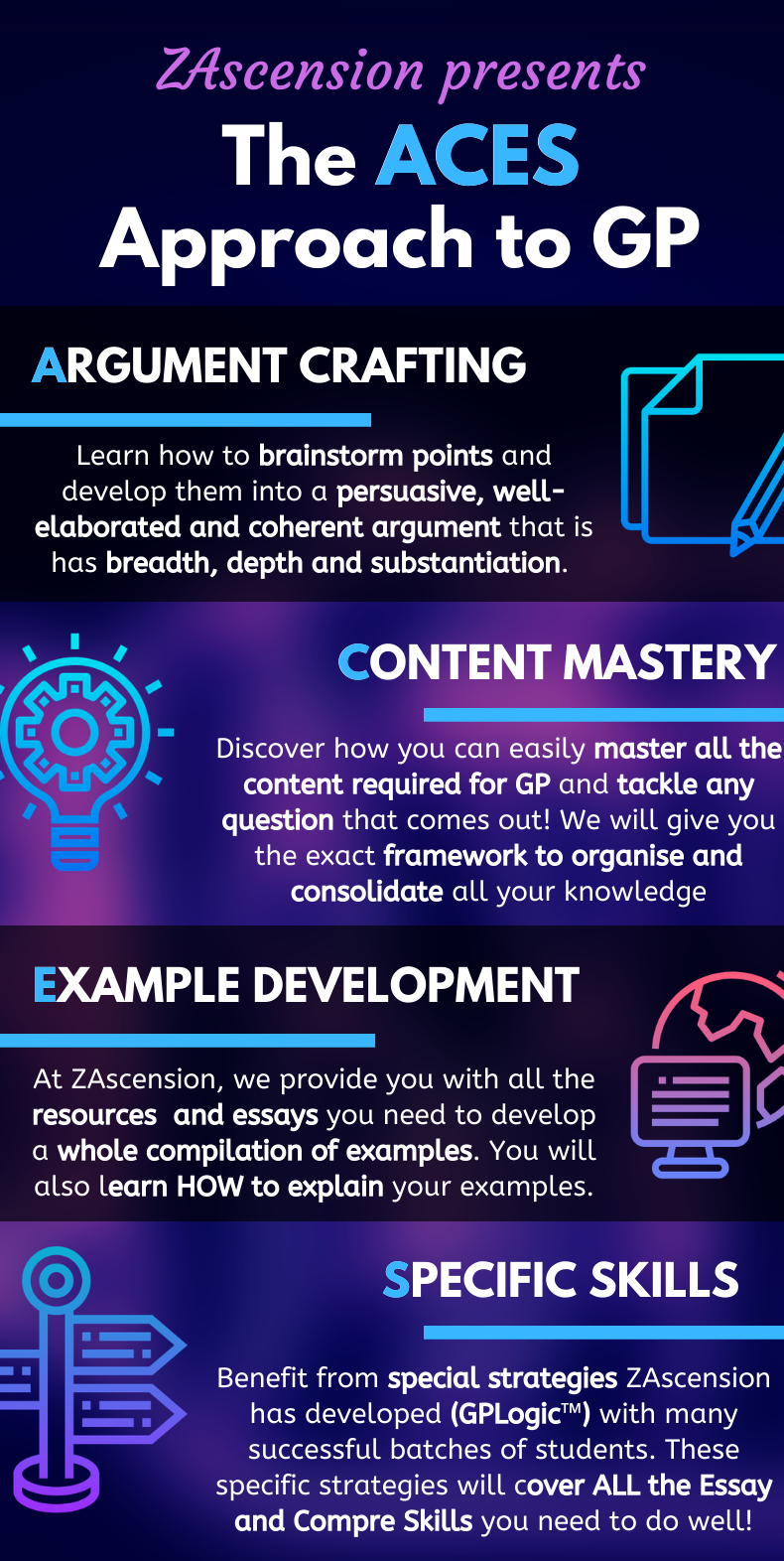
If you appreciate this piece and would like to learn more on how you can also replicate a high quality AQ, consider joining us in our weekly lessons (click to find out more on how you can also benefit!). We will learn all these and much more to conquer all the GP requirements. From our lessons, there will also be many more such samples available 🙂 And of course, lessons would include practices where you will also get individualised feedback from Mr Zach for your work, and you will know exactly what and how to improve!
______________________________________________________________________________________________________
Yay, congratulations to the J2s of 2024, because you have completed an important milestone. Good job on putting in your best effort for GP. Now it is time to take a short break and refocus your efforts on other remaining subjects. Stay motivated and stay confident 😄!!
______________________________________________________________________________________________________
If you found this helpful, do check out our GP Tips & Resources Telegram Channel! Click here to join. This channel is meant to act as a GP companion to share knowledge and help all students, regardless of whether they are a part of ZAscension. This resource features Tips of the Day, Answers to FAQs, Articles and many more. So if you enjoyed this article, this channel will definitely be useful for you 😃
Do share this article and also the Telegram channel with everyone you know who is also studying for GP, let’s share the good stuff so that we may all learn 🙂

Don’t worry, that’s why we are here to help!
Find out more about the writer, Mr Zach!
 WhatsApp 9722 3187 (click to contact) to sign up for lessons!
 Check out our GP Tips & Resources Telegram Channel! Click here to join.